GEOS Elastic Cylinder
A simple simulation is considered to verify that the Micromorphic Filter may be used to upscale GEOS DNS.
DNS files are copied from the PetaLibrary into a local directory “peta_data_copy” using the following command. This command usually only needs to be used once. Files are copied using the secure copy protocal (SCP). A user will be asked for their identikey, password, and two factor authentication (2FA).
$ scons --peta-data-copy
The analysis is executed in individual stages by the
GEOS_elastic_cylinder SConscript.
First, the existing
DNS results are processed into the required XDMF file format for
the Micromorphic Filter using the following command:
$ scons GEOS_elastic_cylinder_multi_domain
Next the homogenization is performed. Macroscale meshes with 1, 24, 48, and 192 are considered for the default configuration.
$ scons GEOS_elastic_cylinder_multi_domain --filter
DNS
GEOS is an explicit dynamics code, so simulating quasi-static loading is challenging. A displacement of about 0.125 mm is applied to the top face of a cylinder over 100 microseconds. Boundary conditions are chosen to approximate uniaxial stress. Figure 42 shows the force vs displacement and final displacement field of the DNS. Orange markers in Figure 42 denote the frames chosen for upscaling. The force is roughly linear, though the variations indicate the dynamic nature of the simulation.
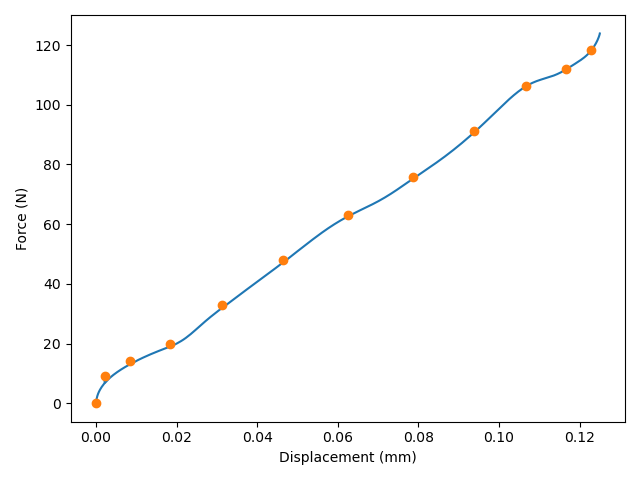 (a) Force vs displacement with markers denoting frames chosen for upscaling
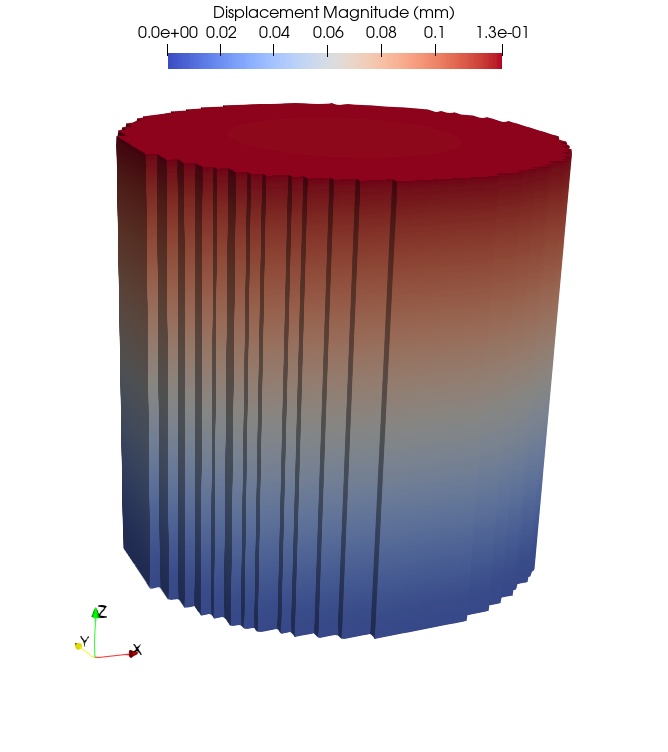 (b) Displacement field
Fig. 42 GEOS elastic cylinder simulation force vs displacement
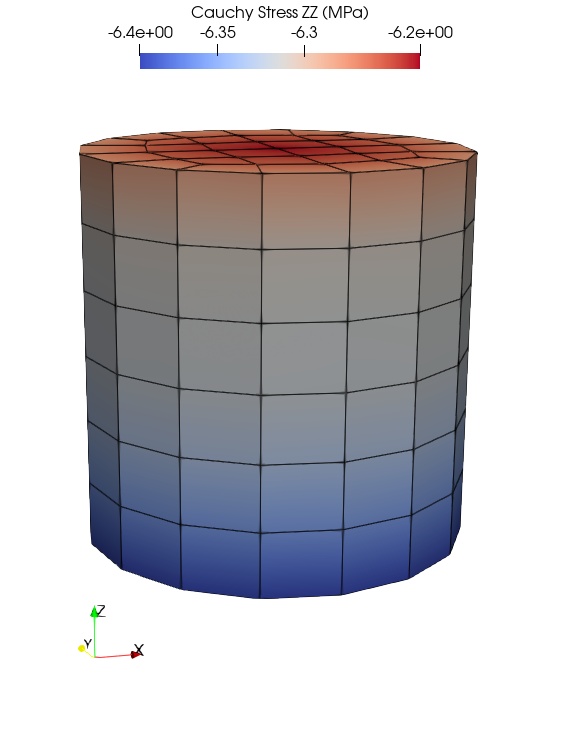
The Cauchy stress (ZZ component) is plotted for the final time step in Figure 43 showing that stress is approximately uniaxial varying from -6.2 to -6.4 MPa with higher stresses concentrated on the bottom.
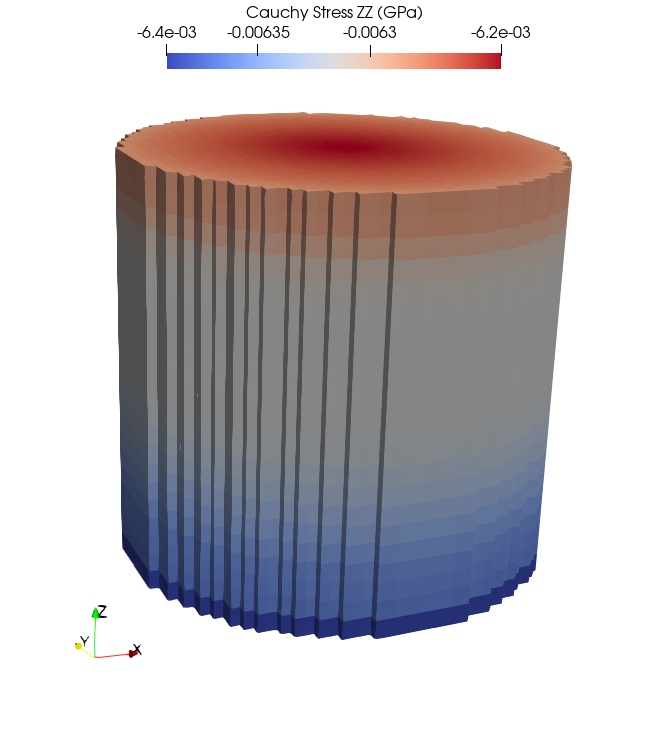
Fig. 43 GEOS elastic cylinder stress
DNS results are converted to the XDMF file format required by the Micromorphic Filter
using the model_package.DNS_GEOS.vtk_to_xdmf script.
Upscaling
DNS results are homogenized using the Micromorphic Filter for 1, 24, 48, and 192 filter domains. Only the results for the 192 element macroscale are presented. Figure 44 shows the homogenized displacement and stress fields for the final time step which generally agree with the results shown in Figures 42 and 43.
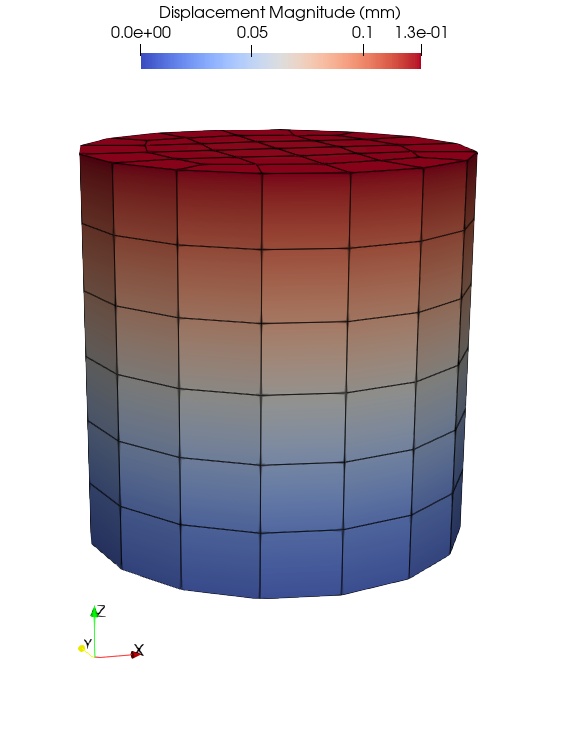 (a) Homogenized displacement field
 (b) Homogenized Cauchy stress ZZ
Fig. 44 Micromorphic Filter results for 192 domains
This study shows that GEOS DNS may be homogenized using the Micromorphic Filter.